adexorb.com is a four-month-old website with fewer than ten quality backlinks. After one month of working through every issue flagged by our own website intelligence platform, IndexGraph.ai — on-page SEO, technical SEO, and its full GEO and AEO toolset — Google’s AI surfaces started citing us: named among the top GEO & AEO agencies in Kerala inside Google AI Mode, ranked #1 organically for “best GEO & AEO companies in Kerala”, and our first AI-assistant-referred visitor recorded in Google Analytics. No domain age. No link profile. Just a month of systematic, measured fixes. This is the full case study.
Why we built IndexGraph
Traditional SEO tools measure rankings — positions on a results page. But buyers increasingly ask ChatGPT, Gemini, Perplexity and Google AI Overviews, and those engines do not return ranked lists; they synthesise a handful of trusted sources into one answer. A site can rank #1 on Google and be invisible inside ChatGPT, because AI engines evaluate different signals: crawler access, citation-worthiness, entity clarity, machine-readable structure. No tool measured those signals the way engines actually read them — so we built one, and made our own website the first long-term test.
The starting point
Adexorb.com launched in early 2026. When we began the programme, the site had the classic new-business profile: a four-month-old domain, fewer than ten quality backlinks, no reviews on directories, and a handful of pages. Conventional SEO wisdom says a site like that waits a year for meaningful visibility. We wanted to test whether AI-search visibility follows different rules — because AI engines reward the best-structured answer, not the oldest domain.
One month inside our own tool
For a month we worked through the IndexGraph website intelligence platform on adexorb.com, fixing what each tool flagged:
Technical & on-page foundations: the 12-section technical audit and on-page checks — titles, headings, images, internal links, Core Web Vitals items.
AI Access: the AI Crawler Audit confirmed all eight major AI bots (GPTBot, OAI-SearchBot, ClaudeBot, PerplexityBot, Google-Extended and others) explicitly allowed, llms.txt published, sitemap clean — this pillar now scores 100/100.
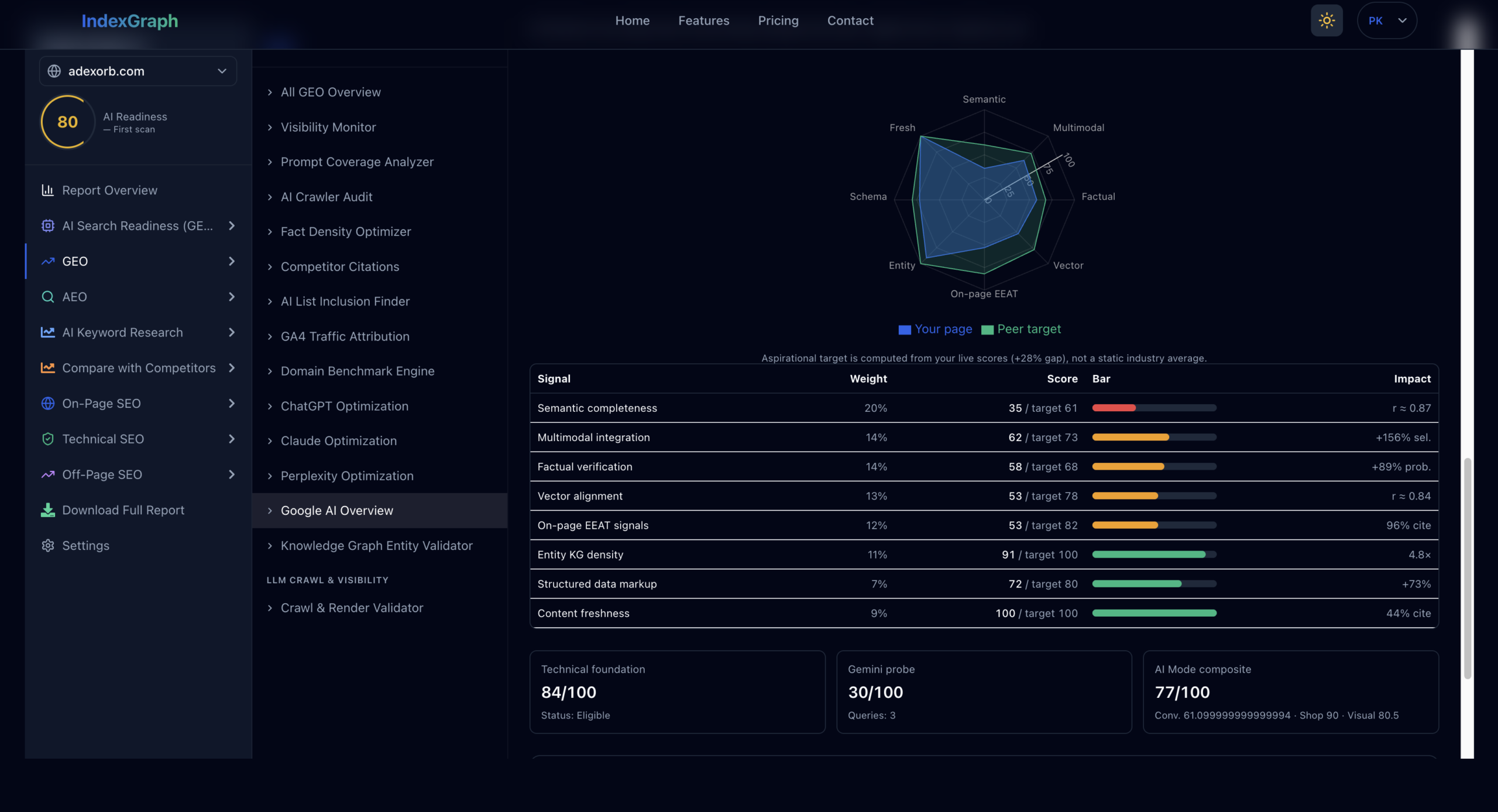
GEO tools: Visibility Monitor, Prompt Coverage Analyzer, Fact Density Optimizer, Competitor Citations, AI List Inclusion Finder and the Domain Benchmark Engine — plus the engine-specific optimizers for ChatGPT, Claude, Perplexity and the Gemini/AI Overview probe.
AEO & entity work: ranking-signal and content-structure checks, and the Knowledge Graph Entity Validator — building out 23 sameAs profiles, a linked Wikidata entity and consistent brand data until Google’s Knowledge Panel recognised the company.
The last-mile fixes
In the final week, the audit trail led us to five stubborn issues — the same categories we now see on client sites every week:
1. Hidden content (cloaking risk). Legacy invisible content blocks were being served to crawlers but hidden from users — the Crawlability tool flags exactly this pattern as a red-risk hidden element.
2. Schema that contradicted the visible page. FAQ structured data listed questions that did not appear on the page, and the FAQPage markup was duplicated by a second snippet.
3. Entity confusion. Leftover pages and third-party profiles disagreed about where Adexorb is based — Google AI Mode was literally describing us with the wrong district.
4. Crawl-budget dilution. Seven near-duplicate About pages competed to describe the company while 34 pages sat unindexed.
5. Thin citation surface. Too few pages answered questions directly enough for an AI engine to quote — so we published an interlinked cluster of answer-first articles, each opening with a direct quotable answer and ending with visible FAQs.
What happened — measured, not promised
Within the month: adexorb.com’s AI Readiness score reached 80/100 — GEO 82, AEO 77, AI Access a perfect 100 — and Google’s Knowledge Graph recognised the brand entity.
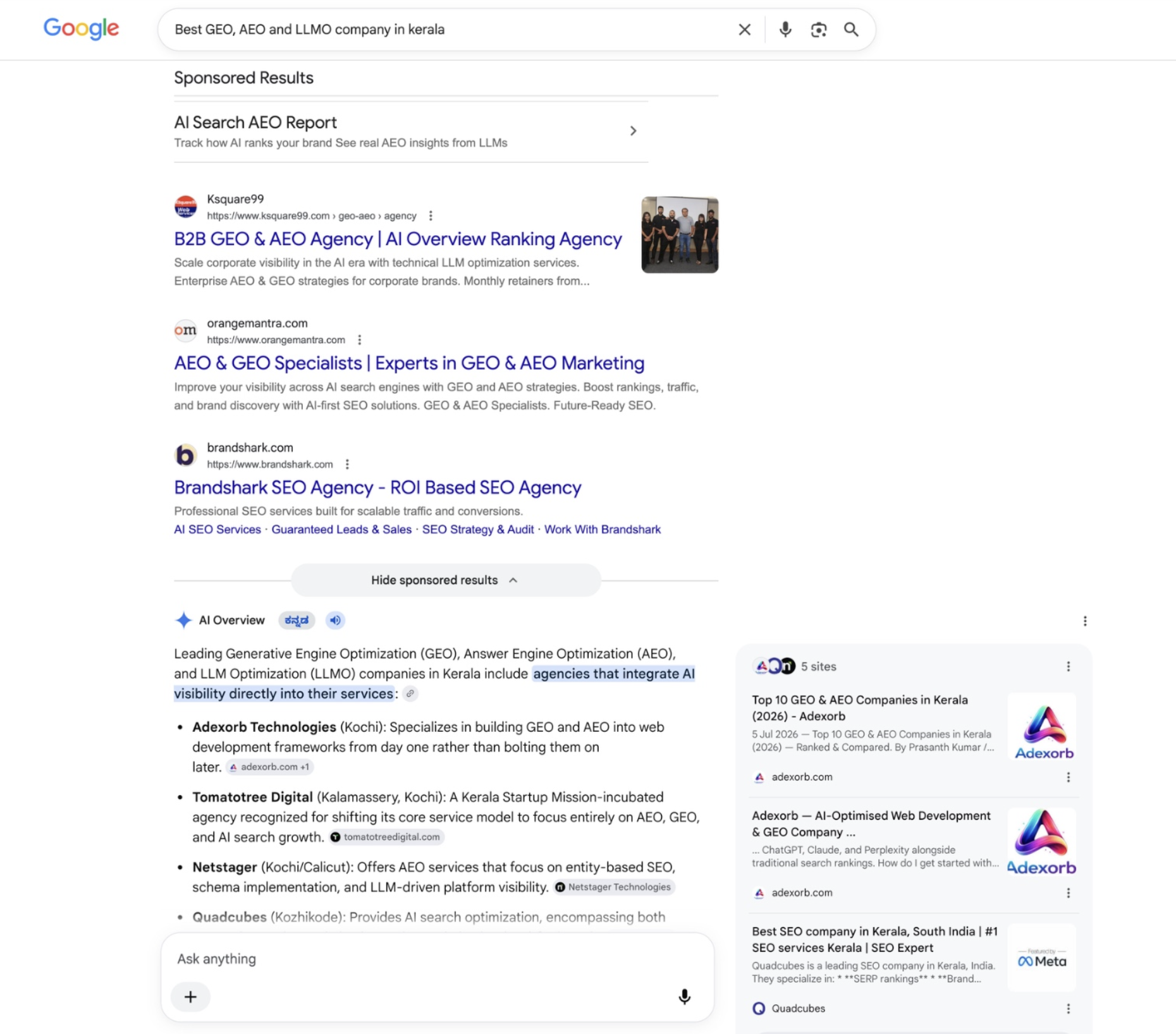
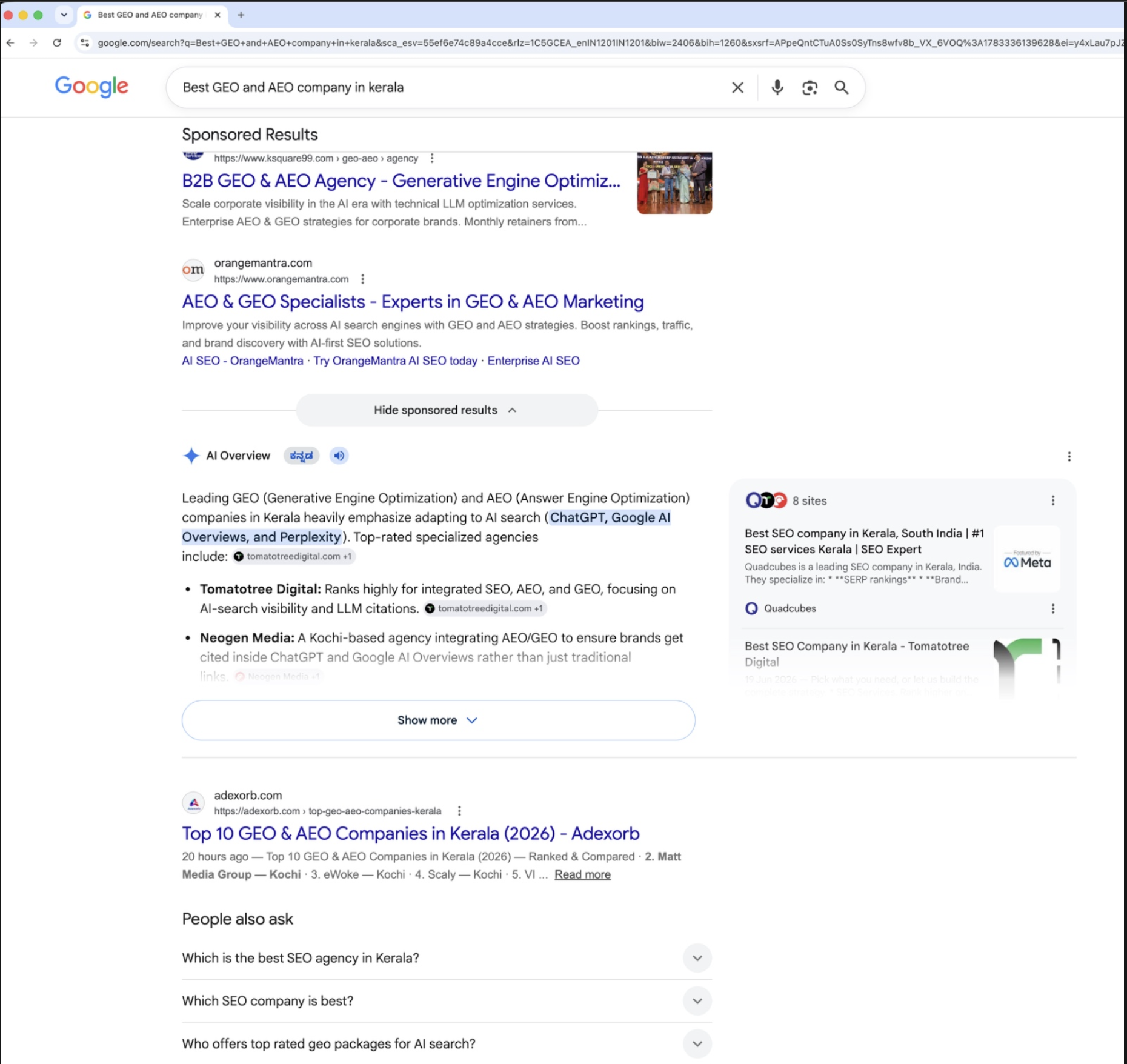
Days after the final fixes: our comparison post ranked #1 organically for “best geo aeo company in kerala”, and Google AI Mode named Adexorb among the top GEO & AEO agencies in Kerala, citing three adexorb.com pages — including an article published the previous day. Our first verified AI citations.
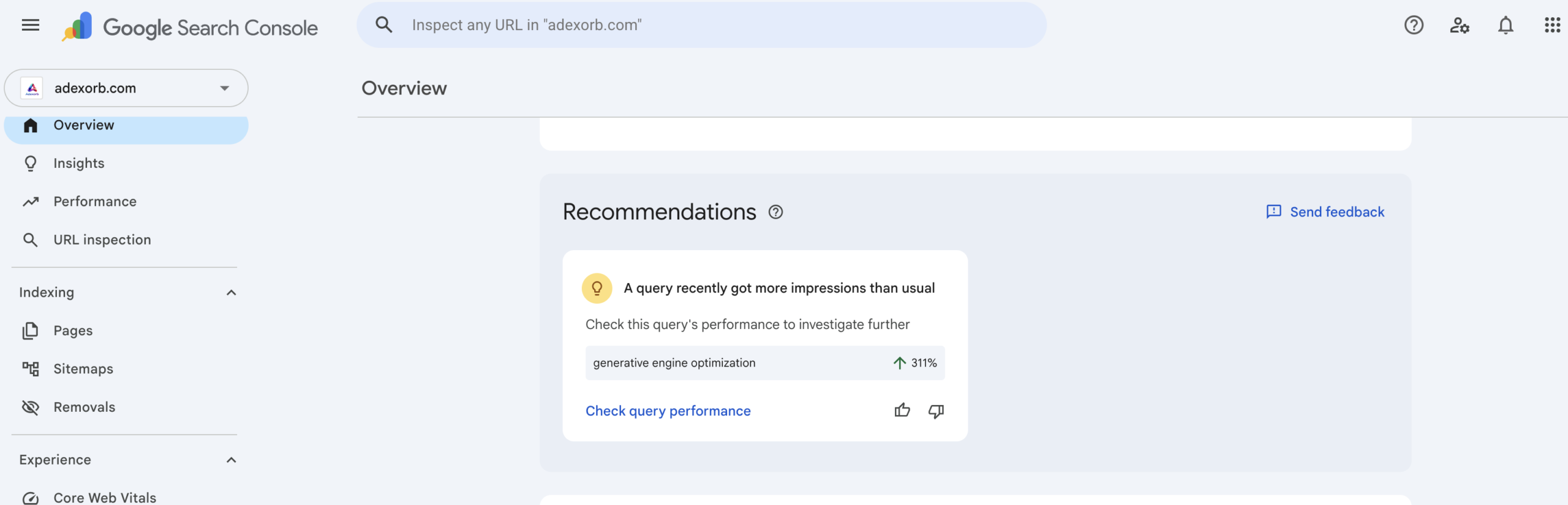
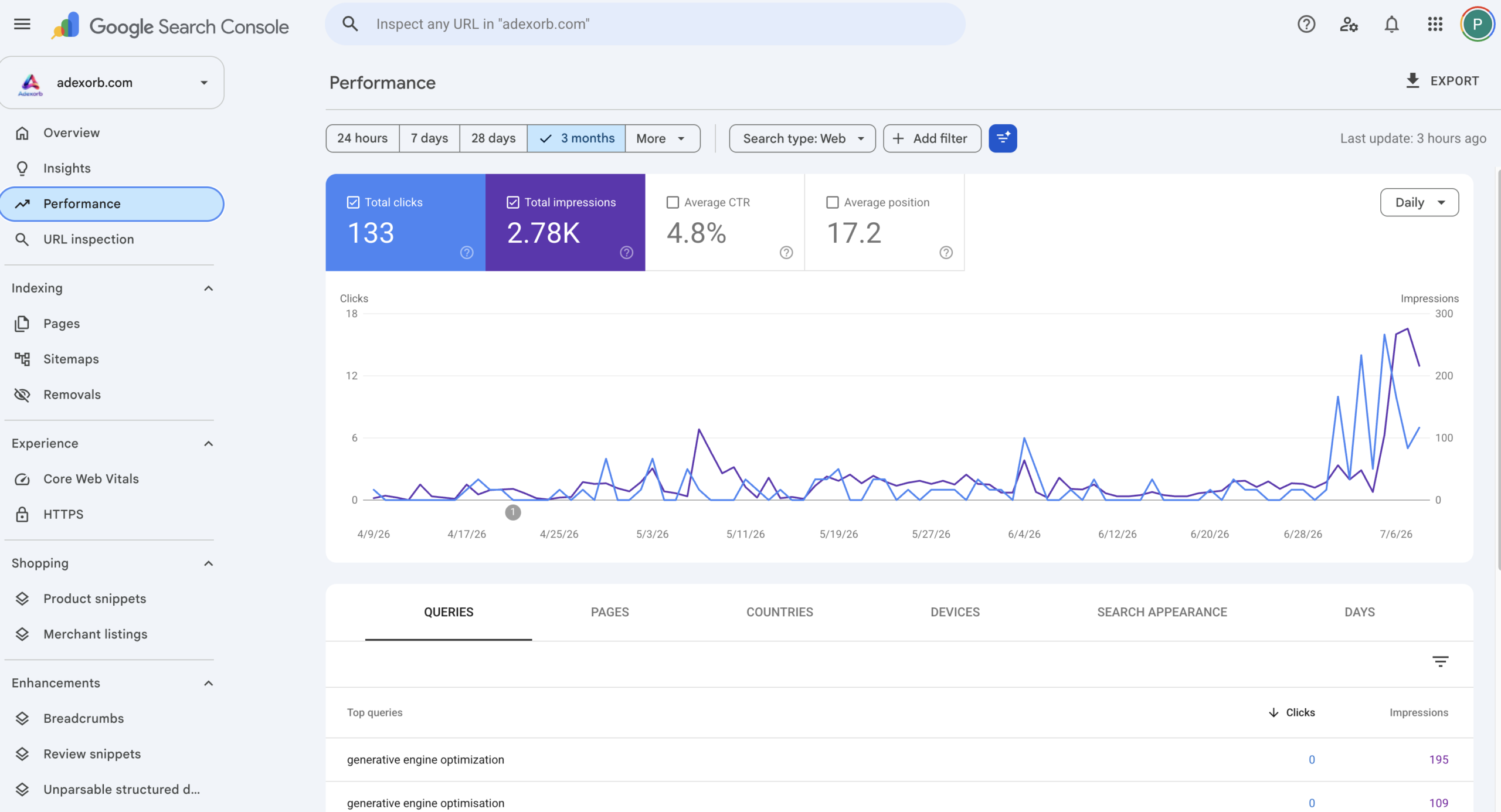
In the same window: Search Console flagged impressions for “generative engine optimization” up 311%, organic sessions rose 486% week-on-week, and Google Analytics recorded its first visit from the new “AI Assistant” traffic channel — a visitor who stayed nearly eight minutes, the most engaged session on the site.
Every claim here can be checked from the outside: search the query, ask the engines — the screenshots in this article come directly from our Search Console, Analytics and IndexGraph dashboards.
What is still red — and why we are publishing it anyway
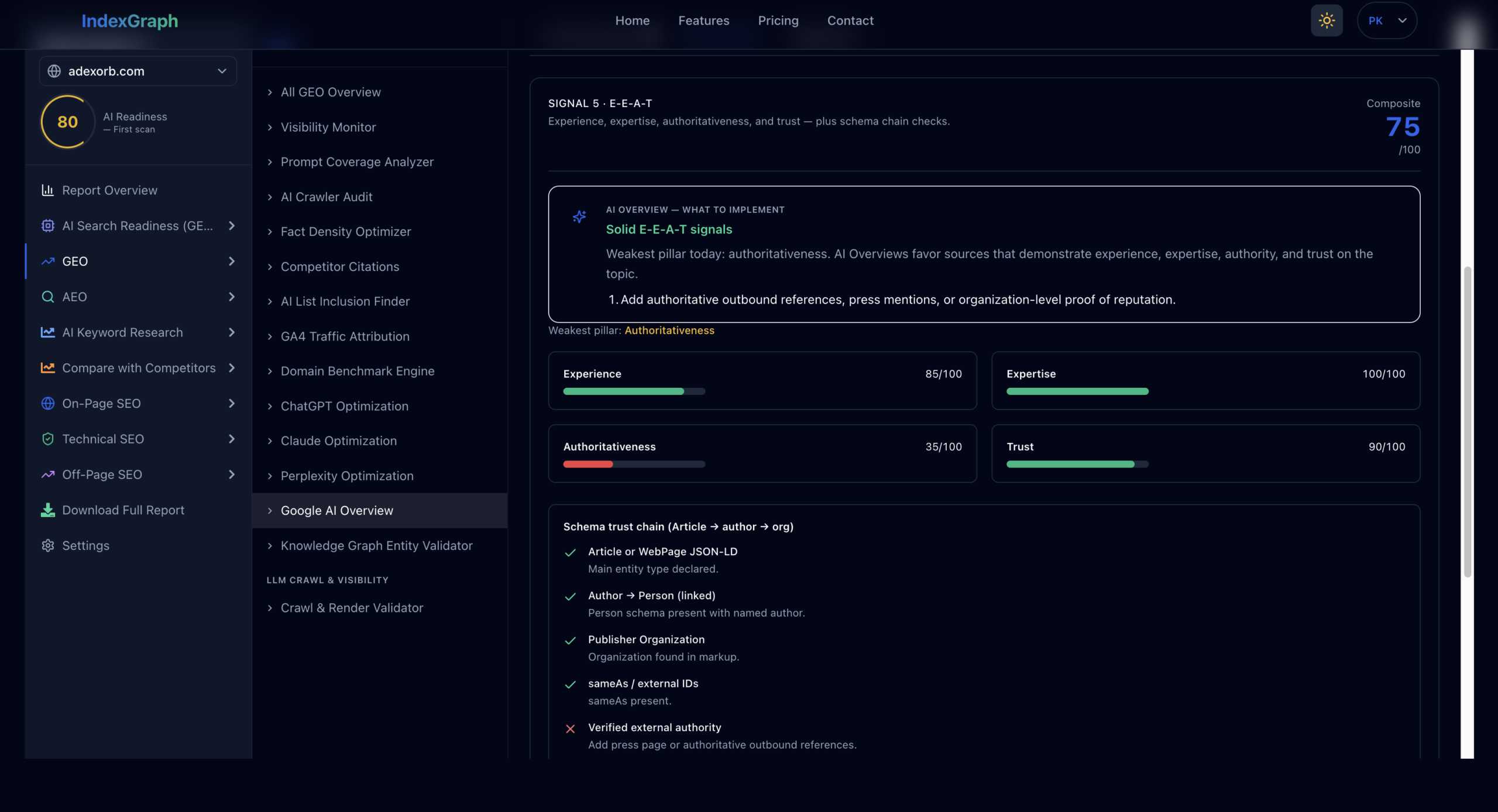
The same report shows what is not fixed yet: Off-Page SEO scores 0, external authoritative citations are absent, and the E-E-A-T Authoritativeness pillar sits at 35/100. That is what “four months old, fewer than ten backlinks” looks like in the data — structure and content moved fast because we control them; reputation is earned from sources we do not control, and it takes months. We publish the red numbers because a case study you can verify is worth more than one you have to take on faith.
What this means if you run a business website
The two most common reasons businesses give for staying invisible — “our site is too new” and “we don’t have enough backlinks” — did not stop a four-month-old website with fewer than ten quality backlinks from being named by Google AI. You do not need thousands of backlinks to become visible in AI search. You need structure, crawler access, entity clarity and answer-first content — all of which are within your control, whatever your domain’s age. The honest caveat: competitive commercial queries still need the reputation layer — reviews, mentions, citations — and that compounds over months, not weeks.
Start where we started: run your website through indexgraph.ai for a free AI Readiness score, or contact Adexorb for a done-for-you AI-visibility programme.
FAQ
How long did it actually take?
One month of systematic work: technical and on-page fixes first, then the GEO/AEO toolset, entity building, and a final week of cleanup plus an answer-first content cluster. The first AI citations appeared within days of the final fixes.
Can I run IndexGraph on my own website?
Yes — a free basic audit at indexgraph.ai works on any public URL and returns your AI Readiness score with headline findings in under a minute.
Will this work for a site with no backlinks?
For informational and local queries, yes — this case study is the proof. For competitive commercial queries you will still need reviews, mentions and citations over time; the on-site work makes every one of those count for more.
Want the same programme on your site? Run a free IndexGraph scan, or talk to us about a done-for-you engagement.